
Anúncios
Throughout history, the ancient gods have been silent witnesses to humanity’s greatest triumphs and most devastating collapses, observing civilizations rise from dust only to crumble back into myth.
🏛️ The Eternal Watchers: Divine Perspectives on Human Folly
Imagine standing at the precipice of eternity, watching generations flicker past like candles in the wind. This was the vantage point of the ancient gods—immortal observers who saw empires stretch toward the heavens only to topple under the weight of their own ambition. From the heights of Mount Olympus to the banks of the Nile, these divine entities witnessed patterns that mortals, trapped in their brief lifespans, could never fully comprehend.
Anúncios
The concept of gods watching civilizations fall is more than mere mythology. It represents humanity’s attempt to understand catastrophic change through a lens that transcends individual experience. These mythic narratives offered ancient peoples a framework for processing collective trauma, giving meaning to chaos and providing cautionary tales for future generations.
The fallen civilizations of antiquity didn’t disappear in silence. Their collapse echoed through religious texts, epic poems, and sacred warnings. The gods, according to these accounts, didn’t simply observe—they judged, they warned, and sometimes they intervened. Yet most often, they let the natural consequences of human choices play out across the stage of history.
Anúncios
When Zeus Watched Troy Burn: The Divine Gaze on War’s Devastation
The fall of Troy remains one of history’s most enduring symbols of civilizational collapse. According to Greek mythology, the gods themselves were divided during the Trojan War, with some supporting the Greeks and others defending the Trojans. Yet beyond their partisan involvement, there existed a deeper narrative—one of divine observation of humanity’s capacity for both glory and self-destruction.
Zeus, king of the gods, watched from his throne as the city that had stood for generations succumbed to Greek cunning and military might. The Trojan Horse, that infamous wooden vessel of deception, carried within it the seeds of total annihilation. The gods knew the outcome long before the first Greek warrior emerged from the horse’s belly, yet they allowed fate to unfold.
This mythological account reflects a profound truth about civilizational collapse: the warning signs are often visible long before the final fall. Troy’s downfall began not with the horse, but with Paris’s abduction of Helen, with pride that refused diplomatic solutions, with walls believed impenetrable. The gods saw what mortals, blinded by hubris, could not.
Divine Warnings Ignored: A Pattern Across Pantheons
The theme of ignored divine warnings appears repeatedly across mythological traditions. In Mesopotamian texts, the gods warned of floods that would cleanse the earth of human corruption. In Norse mythology, the prophecies of Ragnarok foretold the destruction of the gods themselves alongside the world they governed. These weren’t simply stories about divine power—they were sophisticated narratives about societal collapse encoded in religious metaphor.
The Epic of Gilgamesh, one of humanity’s oldest written stories, contains the tale of Utnapishtim and the great flood sent by the gods to destroy civilization. While one god decreed destruction, another whispered warnings, allowing a remnant to survive. This pattern of divine warning followed by human disregard appears across cultures because it reflected observed reality: societies that ignored existential threats often faced catastrophic consequences.
🌊 The Flood Narratives: When Gods Reset Civilizations
Flood myths appear in virtually every ancient culture, from Sumerian tablets to biblical texts, from Hindu scriptures to indigenous American traditions. These stories share remarkable similarities: a civilization becomes corrupt or fails to honor the divine, the gods decide to destroy it through flood, and a chosen few are warned to preserve life and knowledge for a new beginning.
The consistency of flood narratives across disconnected cultures suggests they may be rooted in actual catastrophic events—whether local flooding disasters, the end of the Ice Age sea level rise, or other climate catastrophes. What’s fascinating is how these memories became mythologized as divine judgment, transforming natural disaster into moral lesson.
In the biblical account, God observes humanity’s wickedness and declares: “I will blot out man whom I have created from the face of the land.” Yet even in destruction, there’s preservation—Noah’s ark becomes a vessel not just of survival but of continuity, carrying the seeds of the old world into the new. The gods, in their role as witnesses, also become editors of history, deciding what deserves to continue and what must end.
The Mesopotamian Perspective: Divine Regret and Intervention
In the Mesopotamian flood story, the gods’ decision to destroy humanity through flood is later regretted by some deities. Ea, the god of wisdom, circumvents the other gods’ decree by warning Utnapishtim through a dream. This introduces a nuanced element to the divine witness narrative—the gods themselves are conflicted about civilization’s destruction.
This internal divine conflict mirrors human ambivalence about societal transformation. When civilizations fall, there’s simultaneously a sense of inevitability and tragedy, justice and loss. The mythological framework allowed ancient peoples to express these complex emotions through characters with cosmic power but recognizably human psychology.
⚡ The Gods of Egypt: Witnessing Dynasties Rise and Fall
Egyptian mythology offers perhaps the most extensive divine witness to civilizational change. Over three millennia, the gods of Egypt watched kingdom after kingdom rise along the Nile—the Old Kingdom with its pyramid builders, the Middle Kingdom with its literary flowering, the New Kingdom with its imperial expansion, and countless periods of intermediate collapse and reformation.
Ra, the sun god, made his daily journey across the sky throughout all these transformations, an unchanging celestial witness to earthly impermanence. Osiris, god of death and resurrection, embodied the cycle itself—the eternal pattern of death and rebirth that civilizations undergo. Egyptian theology didn’t view civilizational collapse as aberration but as part of the cosmic order, the necessary death that precedes renewal.
The concept of Ma’at—cosmic order, truth, and justice—was central to Egyptian thought. Civilizations fell, according to this worldview, when Ma’at was abandoned in favor of isfet (chaos). The gods didn’t capriciously destroy; they simply withdrew their support when humans violated the fundamental order. This philosophical framework provided Egyptians with both explanation for collapse and prescription for prevention: maintain Ma’at, and civilization endures.
The Prophecies of Neferti: Divine Foreknowledge of Collapse
The Prophecies of Neferti, an Egyptian text from the Middle Kingdom, presents a remarkable account of predicted civilizational collapse. The sage Neferti describes a coming time of chaos: “The land is diminished, but its administrators are many; bare, but its taxes are great; little in grain, but the measure is large.”
This text, likely written after the events it “predicts,” demonstrates how ancient civilizations used divine foreknowledge narratives to make sense of historical trauma. By placing knowledge of collapse in the mouths of prophets and gods, societies could find patterns in chaos and lessons in catastrophe.
🗿 Mesoamerican Cycles: Gods and the Inevitable Fall
Mesoamerican mythology took the concept of civilizational collapse and made it cosmic law. The Aztec belief in five successive worlds or “suns”—each destroyed in turn—represented perhaps the most explicit mythological acknowledgment that civilizations inevitably fall. The gods, in these traditions, didn’t prevent collapse because collapse was built into the universe’s structure.
According to Aztec cosmology, the current world (the Fifth Sun) was destined to end in earthquakes, just as previous worlds had ended in jaguars, wind, fire, and flood. This wasn’t pessimism but realism encoded in myth. Civilizations did fall—Maya city-states were abandoned, Teotihuacan collapsed, Toltec power waned—and the mythological framework provided meaning to these experiences.
The gods who created each successive world weren’t absent observers but active participants who sacrificed themselves to set each new sun in motion. Quetzalcoatl and Tezcatlipoca, in various myths, both create and destroy worlds. This divine involvement in both creation and destruction reflected sophisticated thinking about how the same forces that build civilizations also contain seeds of their undoing.
🔥 Norse Ragnarok: When Even Gods Must Fall
Norse mythology’s Ragnarok presents the most radical vision of civilizational collapse—one that encompasses not just human societies but the gods themselves. In this twilight of the gods, Odin and Thor, Freyr and Heimdall all face their destined deaths alongside the world they’ve governed. The great tree Yggdrasil trembles, the sky splits open, and fire consumes the cosmos.
What makes Ragnarok particularly powerful is that the gods know it’s coming. The Norns, weavers of fate, have shown Odin the future, and he’s spent ages preparing—gathering the greatest warriors to Valhalla for the final battle, seeking wisdom even at the cost of his eye. Yet despite foreknowledge and preparation, the collapse cannot be prevented, only faced with courage.
This mythic framework offered Viking-age peoples a way to conceptualize existential threats that couldn’t be avoided—climate shifts, invasions, the slow transformation of their world through Christianization. If even the gods must fall, then human civilizations falling becomes not shameful but dignified, part of a larger cosmic pattern.
The Seeds of Renewal in Destruction
Yet Ragnarok doesn’t end with destruction. After the fires die and the floods recede, the earth rises again from the sea, green and fertile. Surviving gods find each other in the ruins and discover golden game pieces from the old world. Two human survivors emerge from shelter to repopulate the cleansed earth. The witness gods observe not just endings but the eternal cycle of death and rebirth.
🌟 The Divine Archive: What Gods Remember When Civilizations Forget
One of the most intriguing aspects of gods as witnesses to civilizational collapse is their role as cosmic archivists. Humans forget—within generations, the specifics of why a civilization fell can blur into legend. But gods, in their immortality, remember. They carry forward the lessons that mortals lose in the chaos of collapse.
This divine memory function appears across mythological traditions. The Hindu concept of the Akashic Records—a cosmic library containing all knowledge of past, present, and future—exemplifies this idea. Greek Mnemosyne, goddess of memory and mother of the Muses, represents memory as a divine function essential to civilization. Without memory of past failures, societies are condemned to repeat them.
The prophet traditions in Abrahamic religions serve a similar function. Prophets channel divine memory, reminding people of forgotten covenants and warning of consequences that divine witnesses have seen before. Jeremiah warned Jerusalem of coming destruction, having accessed divine knowledge of what happens when societies abandon foundational principles. His warnings, like those of many prophets, went largely unheeded—another pattern the divine witnesses repeatedly observed.
📜 Modern Echoes: Ancient Patterns in Contemporary Collapse
The mythic eye on civilizational collapse isn’t merely ancient history—it’s a lens through which we can examine contemporary challenges. Climate change, political polarization, economic inequality, and technological disruption present existential challenges that would have been recognizable to ancient observers, even if the specific mechanisms are new.
The patterns identified in ancient mythology remain relevant: hubris that blinds leaders to obvious dangers, short-term thinking that sacrifices long-term stability, inequality that erodes social cohesion, environmental degradation that undermines material foundations. The gods witnessed these patterns repeatedly across millennia and across cultures, encoding warnings in stories meant to transcend their specific historical contexts.
Modern society, despite its technological sophistication, shows many signs that worried ancient observers. We ignore scientific warnings about climate change much as ancient peoples ignored prophetic warnings. We pursue economic growth that enriches elites while impoverishing commons, reminiscent of the late-stage Roman Empire. We trust in walls and weapons while neglecting the social bonds that truly maintain civilizations, echoing the false confidence of Troy’s defenders.
What Would the Gods See Today?
If we imagine the ancient gods observing our contemporary civilization, what would they witness? Likely a familiar paradox: unprecedented capability paired with dangerous fragility, remarkable knowledge coexisting with persistent foolishness, connection across the globe alongside deepening divisions within communities.
They would see patterns they’ve observed countless times—the belief that “this time is different,” that past rules don’t apply, that collapse happens to others but never to us. They would recognize the warning signs visible to those willing to see: ecological systems approaching tipping points, political systems losing legitimacy, economic systems generating unsustainable inequality, social systems fraying under stress.
🌅 The Wisdom of Witnessing: Lessons from Mythic Observation
What can we learn from the concept of gods as witnesses to civilizational collapse? First, that perspective matters enormously. Trapped in the immediate pressures of daily life, we struggle to see long-term patterns. The divine witness perspective—looking across generations and civilizations—reveals patterns invisible to participants caught in the current of events.
Second, that collapse is rarely sudden despite appearing so to contemporaries. The gods watching Troy knew the city’s fate was sealed long before the horse entered the gates. The flood gods observed corruption accumulating across generations before sending the waters. Ragnarok was prophesied ages before it arrived. Civilizational collapse is a process, not an event, and the seeds are often visible long before the harvest.
Third, that human agency matters even within larger patterns. The gods might see the cycles and patterns, but individual choices still matter. Noah chose to build the ark. Utnapishtim chose to heed the warning. Cities that maintained Ma’at endured while those that abandoned it fell. The witness gods observed both the patterns and the exceptions, the inevitabilities and the possibilities.
Finally, that endings contain beginnings. Every mythological tradition that includes civilizational collapse also includes renewal. The flood waters recede, revealing cleansed earth. After Ragnarok comes rebirth. The Fifth Sun follows the Fourth. The gods witness not just destruction but transformation, not just death but the eternal cycle of death and rebirth that characterizes existence itself.
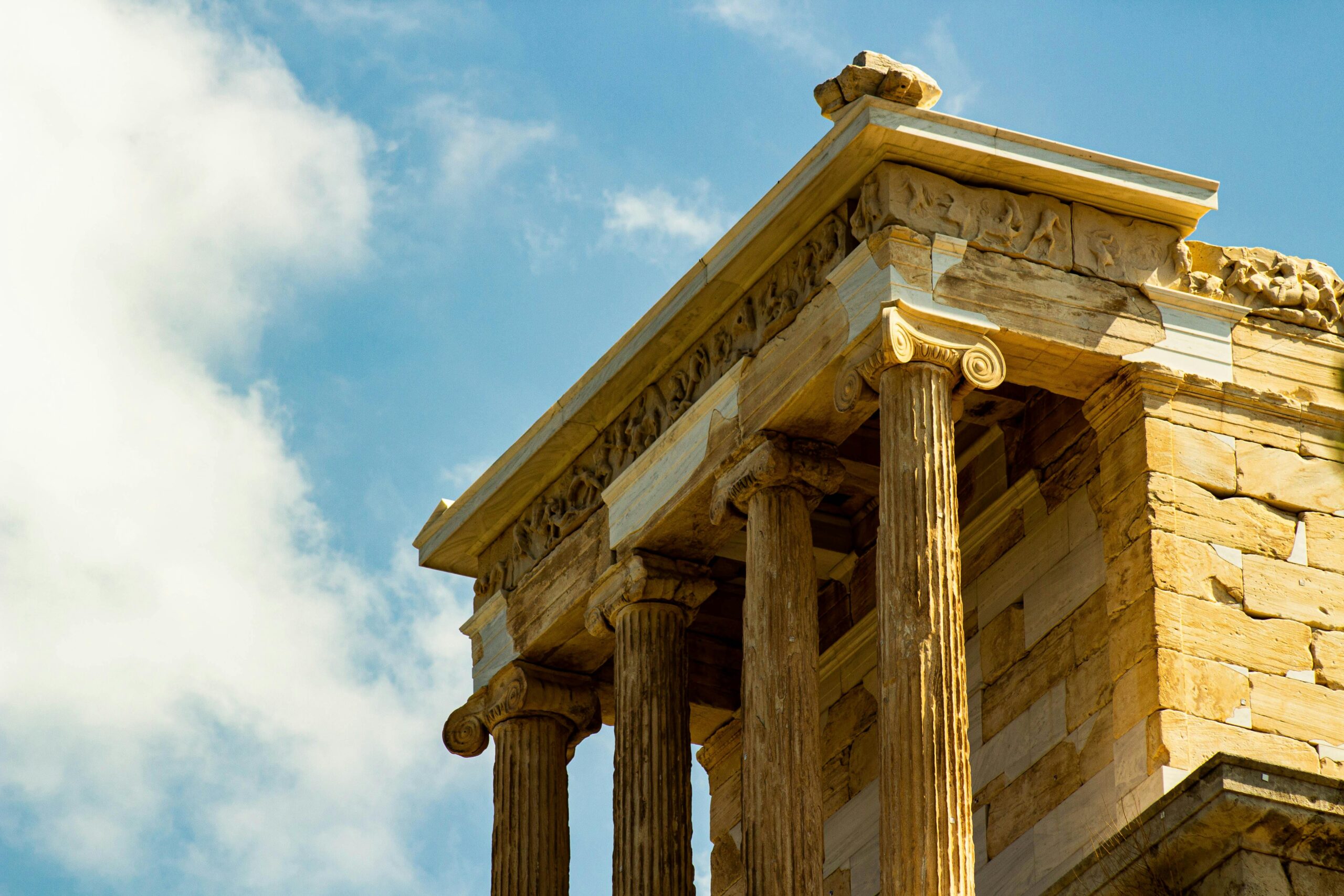
The Eternal Return: Civilizations in Cosmic Context
The ancient gods, in their role as witnesses to civilizational collapse, offer humanity something precious: perspective. They remind us that our current civilization, despite its uniqueness, participates in patterns that transcend particular times and places. This perspective isn’t meant to induce fatalism but wisdom—the recognition that civilizations, like all living things, have life cycles, and that understanding these cycles allows for conscious participation rather than unconscious repetition.
The mythic eye sees what mortal eyes often miss: that civilizations fall not primarily through external conquest but internal decay, not through singular catastrophes but accumulated negligence, not through the absence of warnings but the refusal to heed them. The gods witnessed societies that had every resource necessary for continuation choose instead the paths that led to collapse, blinded by hubris, greed, short-sightedness, or simple inertia.
Yet the divine witnesses also observed remarkable resilience, surprising renewals, and moments when societies changed course despite the weight of precedent. They saw wisdom emerge from catastrophe, saw survivors carry forward essential knowledge, saw new civilizations rise that learned from the ashes of the old. The witness perspective encompasses both the tragedy of repeated failures and the inspiration of persistent hope.
As we face our own civilizational challenges in the 21st century, the ancient gods’ mythic witness offers no simple solutions but profound context. Our problems are urgent and particular, yet they echo problems civilizations have always faced. Our resources are unprecedented, yet so are our vulnerabilities. Like all peoples facing existential challenges, we stand at a crossroads where choices matter and outcomes remain unwritten. The gods, as always, are watching—and waiting to see what we choose to become. 🌍
